Ingredient
Lutein and Zeaxanthin in CogniHoney: What It Is, What the Research Shows and the Safety Flags
Lutein (5%) and zeaxanthin (5%) are two lines in the list given to this site for the sibling pack. In the one large trial that checked, they had no significant effect on a cognitive score. They were tested for eye disease. No amount is printed, and the list does not say what the 5% refers to.
Written by the CogniHoney label deskUpdated
Ingredient01
What are lutein and zeaxanthin?
Two yellow carotenoids found in leafy greens and egg yolk, and in the macula of the eye.
They are close chemical relatives, which is why they travel together in research and on labels. They turn up in food and in the macula of the eye, which is why eye research took an interest in them first.
The CogniHoney list names them as two separate lines, lutein in fifth place and zeaxanthin in tenth. Each carries "(5%)" with no statement of what the 5% refers to. We handle them together here because the evidence does.
| Name in the list | Lutein and Zeaxanthin (printed 5% each) |
|---|---|
| What it is | Two yellow carotenoids found in leafy greens and egg yolk and in the macula of the eye. The list prints '(5%)' for each and does not say what it refers to. |
| Amount in CogniHoney | Not printed in any material given to this site; confirm on your bottle |
| Amount used in research | AREDS2 used lutein 10 mg plus zeaxanthin 2 mg a day for eye disease. The amount in this product is not printed. |
| What research found | AREDS2 tested lutein and zeaxanthin for age-related macular degeneration, not memory. In the AREDS2 cognition study of 3,741 older adults, lutein/zeaxanthin had no statistically significant effect on cognitive scores over about five years. |
| Main caution | Well tolerated in the studies we read; the sources give no specific cautions beyond talking with a doctor before starting a supplement. |
| Medicines to ask about | No interaction named in the sources we read; tell your pharmacist anyway. |
The sibling-pack list separates the pair, so confirm on your bottle whether both are present and whether each shows its own figure.
Ingredient02
Do lutein and zeaxanthin help memory?
In the one large trial that checked, no.
AREDS2 gave lutein 10 mg and zeaxanthin 2 mg a day, with omega-3 in some groups, to 3,741 older adults at risk of macular degeneration, for about five years. It found no statistically significant effect of lutein and zeaxanthin on a composite cognitive score, with a difference in yearly change of 0.03 and a 99% confidence interval of minus 0.14 to 0.19 (Chew 2015, AREDS2 cognition).
That interval spans zero comfortably, in both directions, which is what "no effect detected" looks like. It is a good-sized trial run for a long time, so its silence counts. It does not prove the pair does nothing for every person in every form, but it is the best evidence we found, and it points the wrong way for a memory claim.
Ingredient03
Then why are they studied at all?
Because they were tested for eye disease, where there is a result.
NEI says the AREDS 2 formula, which has 10 mg of lutein and 2 mg of zeaxanthin together with vitamins C and E and minerals, may slow progression in people with intermediate age-related macular degeneration, or late AMD in one eye. It cannot prevent early AMD from becoming intermediate, and it probably will not help late AMD in both eyes (NEI, AREDS 2 supplements).
That is an eye finding in a particular patient group using a particular formula. It is not a memory finding, and it does not carry across to a general capsule. If you have macular degeneration, ask an eye doctor which formula suits you. A general memory capsule may not match it.
Ingredient04
What amount did studies use?
The studied amounts were 10 mg lutein and 2 mg zeaxanthin a day, for eye disease.
| Point | AREDS2 | CogniHoney list |
|---|---|---|
| Lutein | 10 mg a day | Named, (5%), no amount |
| Zeaxanthin | 2 mg a day | Named, (5%), no amount |
| Ratio of lutein to zeaxanthin | 5 to 1 | Cannot be worked out |
| Length | About five years | Not applicable |
| Group | 3,741 older adults at risk of AMD | No trial |
Sources: (Chew 2015, AREDS2 cognition) and (NEI, AREDS 2 supplements). The 5% on each line is printed without a base. It might be the share of a carotenoid in a plant powder, or something else entirely. We cannot say whether a capsule gets near the AREDS2 amounts, and we never estimate one.
Ingredient05
Are lutein and zeaxanthin safe?
The sources we read name no specific cautions for these two.
That is not a clean bill. The studied formula was a specific one, used by older adults at eye risk and under study conditions. NEI advises talking with your doctor before starting a supplement for the eyes (NEI, AREDS 2 supplements), and that holds for any supplement.
The wider list matters more. The capsule also holds ginkgo, which may raise bleeding risk with anticoagulants, and green tea extract, with a liver caution. Reading the lutein line alone would miss those.
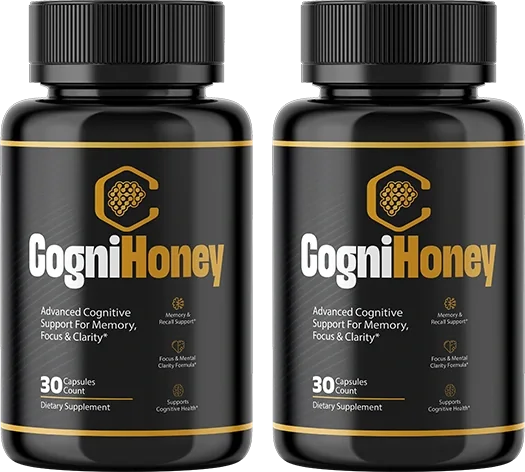
CogniHoney capsules: 30 on the bottle count2, 3 or 6 bottles · 60-day guarantee per seller materials
See packsIngredient06
Do they interact with medicines?
No interaction is named in the sources we read. Tell your pharmacist anyway.
- Give the pharmacist the full ingredient list, not only these two lines.
- Say whether you take any eye supplement already, since lutein and zeaxanthin appear in many.
- Tell your eye doctor about CogniHoney if you have macular degeneration.
- Report any new symptom to your doctor.
An absence of named interactions in the sources we read is not evidence of safety with every medicine.
Ingredient07
What would you need to see on the bottle?
The amounts, and what the percentages mean.
A real panel would show each carotenoid in milligrams. Without it the two 5% figures could describe a plant powder, a purity or a share of the capsule, and each reading leads to a different amount. If you already take an eye supplement, add the lutein across both before deciding, because the same carotenoids appear in many products and intakes stack.
Ingredient08
What should you ask your pharmacist or doctor?
- Is the lutein amount near the AREDS2 amount, and what does the 5% refer to?
- Should I use an eye formula instead if I have AMD?
- Does my eye doctor know about this capsule?
- Do I already get lutein from another product?
See studied doses for the full set of trial amounts.
FAQ09
CogniHoney questions people ask
Is lutein good for memory?
AREDS2 found no significant effect on a cognitive score in 3,741 older adults.
Are lutein and zeaxanthin the same?
They are two related carotenoids found in the eye's macula. The list names them as separate lines.
What does AREDS2 show about eye health?
NEI says its formula may slow progression in intermediate AMD or late AMD in one eye.
What dose of lutein was used in AREDS2?
10 mg of lutein and 2 mg of zeaxanthin a day. No amount is printed for CogniHoney.
What does the 5% mean on the lutein line?
The list does not say. Confirm on your bottle what it refers to.
Where do lutein and zeaxanthin come from?
Leafy greens and egg yolk are natural sources. The list does not say the source in the capsule.
Can lutein replace an eye doctor's advice?
No. NEI says to talk with your doctor before starting an eye supplement.
Who wrote this10
Written and reviewed by
Pages built from the label, the seller checkout and linked NIH, FDA, FTC, CDC and peer-reviewed sources.
Last updated . Read our editorial standards and how we check reviews. This website is the information site for a U.S. authorized retailer of CogniHoney. It is not the manufacturer. We earn money when you buy through our order links.
Keep reading
More about CogniHoney
USA Authorized CogniHoney Retailer
Ready to look at CogniHoney?
Read the bottle you receive, check your medicines with a pharmacist (blood thinners, thyroid, statins and diabetes medicines matter here), then pick a pack. The guarantee is 60 days per the seller's materials; confirm the live wording at checkout.
- Checkout on the sales site
- 60-day guarantee (confirm live)
- Ships from the U.S.